Posts

The Marathon Monks of Mt. Hiei

Image
Straw Sandals Among the many evocative black-and-white photographs that grace this wonderfully strange, if not entirely satisfying, book is the image of a row of straw sandals, hanging illuminated in the darkness.  They look unpromising as protection for the feet, less like shoes than elongated birds' nests held together by bits of string.  Yet these are the sandals worn by the gyoja , the so-called "marathon monks" of Japan, as they run the rocky and frequently rain-slicked paths on the five peaks that make up the mountain complex of Mt. Hiei. One pair of sandals suffices, under ideal conditions, for perhaps a single day of running.  Conditions are frequently not ideal in this part of Japan.  And the gyoja will run far more than a single day at a stretch. In heavy rain, the straw sandals disintegrate in a matter of hours.  So something seems seriously amiss with the figure of 80 pairs of sandals that Stevens tells us is allotted to each monk per 100-day...

Ribbon of Asphalt and Sand: 2013 Graveyard 100 Race Report

Image
"The sea was angry that day, my friend; like an old man trying to send back soup at a deli" -- George Costanza Friday evening before race day, I pulled up to the pier house behind the Hilton in Kitty Hawk to turn over my drop bags and catch the mandatory prerace briefing.   The sky had been clear on the drive over and the weather forecast for the weekend looked promising.  So it was a bit of a shock to step out on to the beach into the full force of the wind.   A chaotic surf pounded away at the pier.  Whitecaps were visible miles from the shore.   Gathered with other runners inside the pier house, I could feel the wooden framework rocking and swaying underfoot like a tethered boat about to snap free. Although the weather system behind all this activity had struck far to the north, its back-end produced coastal surges that flooded and reshaped roads along the 100-mile route.  Race Director Brandon Wilson informed us that there was about a 50/50 chance ...

A Cold Day at the Office: the 2013 ICY-8 Trail Run

Image
One of the reasons some of us have taken our running permanently offroad is the spirit of shared athletic adventure to be found in trail races, ultras in particular.  Competition can be had, of course, if you want that sort of thing, but there are times competition with others, or even with oneself, feels almost beside the point.  You are just out there, alone and with others, part of a shared festival of running, a figure moving through a landscape. This at least is what I'm seeking, and nowhere have I felt the sense of shared endeavor and adventure more strongly than in the 12- and 8-hour trail races--held in September and February, respectively--that are part of an annual cycle of well-organized DC-area events put on by Alex Papadopolous and the folks at Athletic Equation.  (There is a 24-hour version, as well, which I have not run.) Billed as a "paradigm shift," these races allow you to run as much or as little as you like for a set period of time.   The c...

Indian running: the remarkable history and achievements of Native American long-distance runners

Image
A Review of Peter Nabokov,   Indian Running, Native American History & Tradition .  Santa Fe: Ancient City Press, 1981. For better or worse, Chris McDougall’s Born To Run has ensured that the Tarahumara will never again enjoy the status of a “secret” tribe of running prodigies hidden in the canyons of Mexico.   Some twenty-five years before McDougall’s bestseller, Peter Nabokov also wrote about the Tarahumara’s running prowess. He presents them not as freakish extremes, but as part of a continuum, one expression of a long tradition of Indian running that extended across two continents. Nabokov invites us to imagine North and South America before the arrival of Europeans as a New World of runners.  From the Arctic to what is now Argentina, the landscape is networked by countless thousands of trails, paths, and roads.  The network extends through the deciduous forests of the Northeast, across the great plains of North America, through the mountains and ...

Running the MoCo Watershed

Image
This mid-section of the mid-Atlantic state in which I live serves as a vast drainage area, sloping from the Blue Ridge and Appalacian areas in the west to the flat coastal plains in the east.  A map of the MoCo (Montgomery County) watershed looks like the capillarized cross-section of some vital organ.  As I suppose it is. Today's planned 6-hour run begins in a dense early morning fog at the small parking area in front the ruins of Black Rock Mill.  I am here, not the trailhead at Riley's Lock, where Seneca Creek flows into the Potomac, because with the soggy past week we've had and warm, almost spring-like January day, parts of the lower lying portion of the Seneca Greenway Trail will likely have turned to bog.   For the first half hour, I move slowly, warming up the legs and picking my way carefully along the muddy track.  River and forest are wreathed in fog.  The air is damp, cool but not cold--not a typical day for January.  Along t...

2013 PHUNT 50K, Fair Hill, MD

Image
This low-key trail race takes place early every January in the northeast corner of Maryland, just miles from the border with Delaware and Pennsylvania.  It meant an early start and a 1 and 1/2 hour drive from Silver Spring.  Not so bad.  Since the race begins at a leisurely 9AM, I had time to eat and digest a good breakfast, get a quick shot up an unusually empty 95 North, and enjoy the sunrise while crossing the Susquehanna.   I was one of the first to arrive.  I dropped off my canned goods for the food drive, handed over my contribution for the aid tables, and did a little early exploring of the trails. Elkton and Fair Hill NMRA sit at the head of the upper eastern shore of the Chesapeake, but the terrain in this area is not part of the flat sandy coastal plains area of Maryland.  The twisty, hilly, stream-crossed forests and fields of Fair Hill NMRA are part of the same Piedmont Plateau region that includes the trails in my own backyard--Seneca Creek, ...

Running the C & O

Image
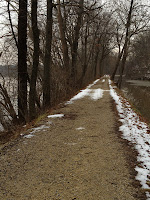
With March's  Graveyard 100  casting a lengthy backwards shadow over my winter training, I've been seeking out extended flat runs to ready myself for this test along the Outer Banks of North Carolina.  Dead-level running hour after repetitive hour poses special challenges, mental and physical.  I am fortunate to live close to the perfect venue for this sort of exercise: the C & O Canal Towpath, 184 magnificent miles along the Potomac, from Georgetown to Cumberland, MD. Last Saturday's plan was to sample 36 of those miles, starting at the Dickerson Conservation Park, a little north of my usual starting point at Riley's Lock or Carderock.  My hope was to keep above the snow/sleet line that tends to snake unpredictably across the middle of our state, and so avoid any hypothermia-inducing cold rain.   There was also the excitement of a running a portion of the path I haven't seen before. Pulling out of Dickerson, I am slapped first by a hissing sleet. ...